The Big Mini Book
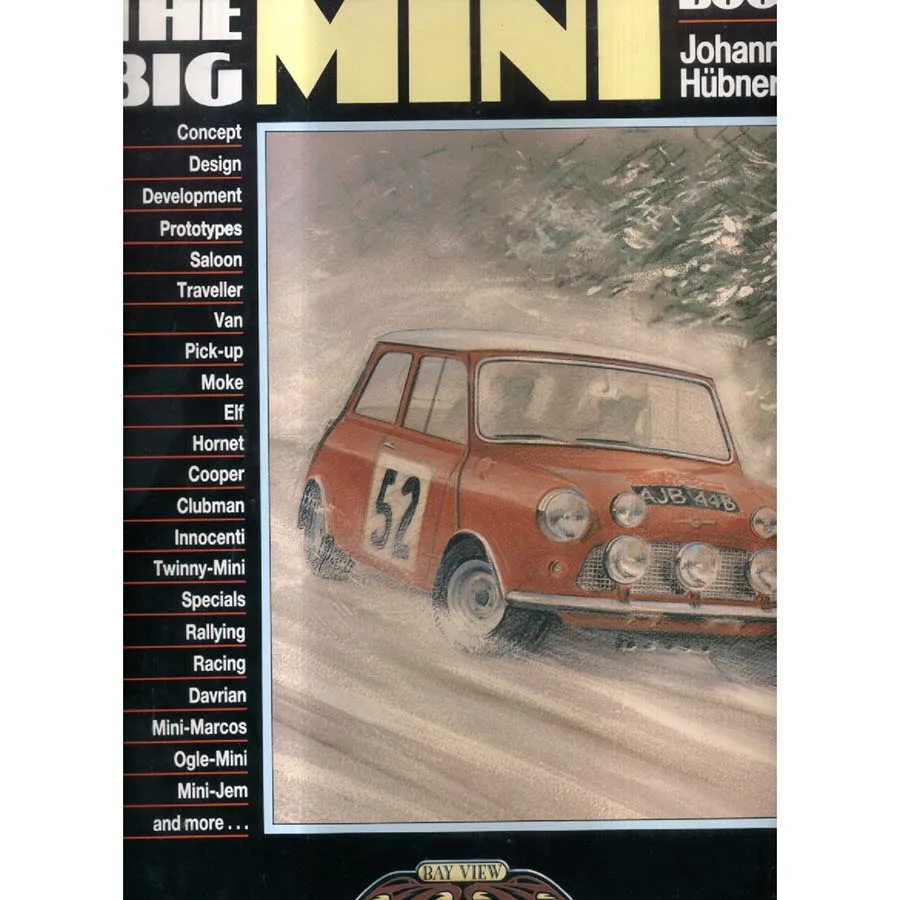
Publisher: Bay View Books
Format: Hardback
ISBN: 9781870979214
There are small cars, there are economical cars, and then there is the Mini, a magnificent little British invention that somehow managed to accommodate four people, their shopping and an extraordinary quantity of national affection within a space barely sufficient for a respectable garden shed. The title The Big Mini Book is therefore a splendid contradiction, although entirely appropriate for a car whose cultural importance was considerably greater than its physical dimensions.
In The Big Mini Book (1992), Johannes Huber celebrates one of the most influential and endearing vehicles in automotive history. Published by Bay View Books, this illustrated volume explores the design, character and extraordinary popularity of the original Mini, a machine that transformed small-car engineering and became an unmistakable symbol of British motoring ingenuity.
Introduced in 1959, the Mini was the product of Alec Issigonis’s determination to create a compact, practical and affordable motor car. Its transverse engine, front-wheel-drive layout and ingenious use of interior space represented a remarkable achievement, allowing ordinary families to enjoy surprisingly spacious transport without needing an equally spacious bank account.
Naturally, the Mini became considerably more than a sensible family runabout. Its cheeky appearance, remarkable handling and enthusiastic personality attracted everyone from students and suburban housewives to celebrities and racing drivers. Few cars have managed to appear equally appropriate outside a modest terraced house and a fashionable London nightclub.
The arrival of the Mini Cooper added an entirely new dimension to the story. Suddenly, Britain’s favourite shopping car was winning international rallies and embarrassing considerably larger machinery. Its celebrated Monte Carlo Rally successes demonstrated that enormous engines and extravagant bodywork were not necessarily required for sporting achievement, particularly when a small car could negotiate corners with the enthusiasm of an overexcited terrier.
Huber’s celebration captures the distinctive appeal of the Mini and its many personalities, from straightforward everyday transport to sporting variations and enthusiast favourites. It recalls an era when automotive designers concentrated on clever mechanical solutions rather than installing increasingly enormous touchscreens and charging customers extra for features that once required nothing more complicated than a switch.
Of course, Mini ownership was not always an entirely carefree experience. Rust, modest luggage capacity, questionable heating and the occasional mechanical disagreement were all familiar aspects of the relationship. Nevertheless, owners remained devoted, presumably because the Mini possessed more charm in one tiny door handle than many modern cars manage across their entire range.
Condition: Very Good. This is a previously owned copy dating from 1992, displaying only modest signs of age and handling. Unlike many surviving Minis of similar vintage, it requires no replacement sills, floorpan welding or investigation into suspicious bubbling beneath the paintwork.
Published by Bay View Books in 1992. ISBN: 9781870979214.
Offered by Crappy Old Books, where we appreciate the magnificent achievements of British automotive engineering, particularly when they can be enjoyed without spending an entire weekend underneath a car with a welding torch.
An excellent addition to any collection of Mini literature, classic British motoring history or automotive nostalgia. Particularly recommended for enthusiasts who appreciate that the Mini proved one essential truth: great things really can come in small packages, even when the package occasionally leaks oil on the driveway.
Keep browsing: See more Transport books Other books by Johannes Huber